

How To Wire An Outlet With 2 Sets Of Wires
How to Wire an Outlet and Add an Electrical Outlet
Use this easy method to install a new electrical outlet without a lot of wire pulling.
 Time
Time
A full day
 Complexity
Intermediate
 Cost
Cost
Less than $xx
Introduction
Eliminate those ugly and often dangerous extension cords. Y'all can add a new outlet apace and easily without vehement open a wall, if yous already have an electrical outlet in the other side of the wall. No extra holes. No messy patching and repainting. The procedure nosotros show here immune the states to center our TV against a wall in the family unit room that had no outlet. Since there was already an electrical outlet in the other side of that aforementioned wall (facing into an adjacent bedroom), nosotros just added a new outlet in the family room, drawing power from the sleeping room outlet.
Tools Required
Materials Required
- Electrical cable
- Receptacle (outlet)
- Remodeling box
- Wire connectors
Yous'll Need to Find a Power Source
This technique only works if you lot can utilize an electrical outlet every bit a power source that'south contrary, or nearly opposite, the identify where you want your new wall outlet. To decide how to wire an outlet and whether you can safely use existing electrical outlets, follow the listing beneath.
You Can Use Another Electrical Outlet When:
- If a switch or outlet is on a circuit that often blows its breaker or fuse. (Don't make matters worse by adding yet another outlet to the excursion.)
- Electrical codes restrict the number of lights or electric outlets that can be continued to one circuit. Typically, you can have no more than than eight lights or electric outlets on a 15-amp circuit. To determine the amp rating of a circuit, simply look at the number on its breaker or fuse in your main electrical panel. Plow off the circuit and exam lite switches and other outlets to determine exactly which lights or outlets are on a given circuit.
- Almost electric codes at present crave outlets in kitchens and bathrooms to be on dissever xx-amp GFCI circuits. And so before using the method we show here for how to wire a wall outlet in a kitchen or bathroom, check with an electric inspector. If you add an outlet to a kitchen or bath, it must exist GFCI protected. Don't power your new outlet from a kitchen or bathroom outlet.
- Codes besides limit the number of wires that can enter an electrical box or electrical receptacle, depending on the within volume of the box and the gauge of the wires. The outlet-addition methods we show here are based on the most common wiring (14-gauge wire on a fifteen-amp circuit) and an 18-cu.-in. box (typical inside dimensions are about 2-in. x iii-1/iv in. x 3-in. deep). If the excursion is 20-amp — which means thicker, 12-approximate wire — or if the existing box is smaller than 18 cu. in., you can't wire a new wall outlet as nosotros show here unless you supercede the existing box with a larger ane. Plastic box sizes are stamped on the inside at the dorsum.
E'er ostend the required box size with your local building inspector. In most regions, you need an electrical permit for this work from your local building department. This helps ensure a safe job. These are the eight most common national electric lawmaking violations.
Picket this video to learn how to install an electrical box in any room in your home:
Piece of work Safely
Before you tackle whatsoever part of this project, turn off the ability to the circuit at the principal electric panel by switching off the breaker or removing the fuse.
Before touching any bare wires or terminals on a switch or outlet, use a voltage tester on all the wires to make certain the power is off. If you have onetime, material-insulated wiring, call an electrician to recommend safe connections. With wiring an outlet like this, there's usually no basis wire and it's hard to tell the hot wire from the neutral, because both are coated with blackness insulation.
Project step-by-pace (5)
Footstep 1
Shut Off the Electric Outlet
- Turn off the power at the main panel. Find the correct breaker and turn it off.
- Once you've adamant the electrical outlet to use as a power source and shut it off, utilize an electronic stud finder to locate the studs on both sides.
- Yous can put your new outlet anywhere between these two studs.
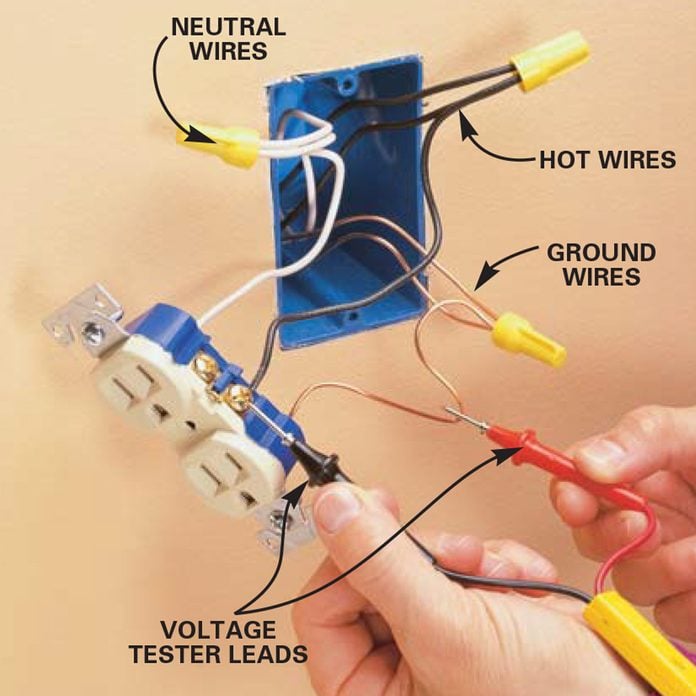
- Unscrew the outlet and use a voltage tester to double-check that the power is off.
- With either lead touching a ground wire (bare copper), affect the other lead get-go to the neutral terminals (silvery colored), and so to the hot terminals (aureate colored).
- If the lite glows with either contact, the circuit is still live.
- Agree the face of the new electrical box against the wall where you lot want it to go, and trace around information technology with a pencil.
- Cut out the hole with a drywall saw.
- Pro tip: Be sure to buy a "remodeling" box that can be secured to the drywall, non i that must be mounted on a stud.
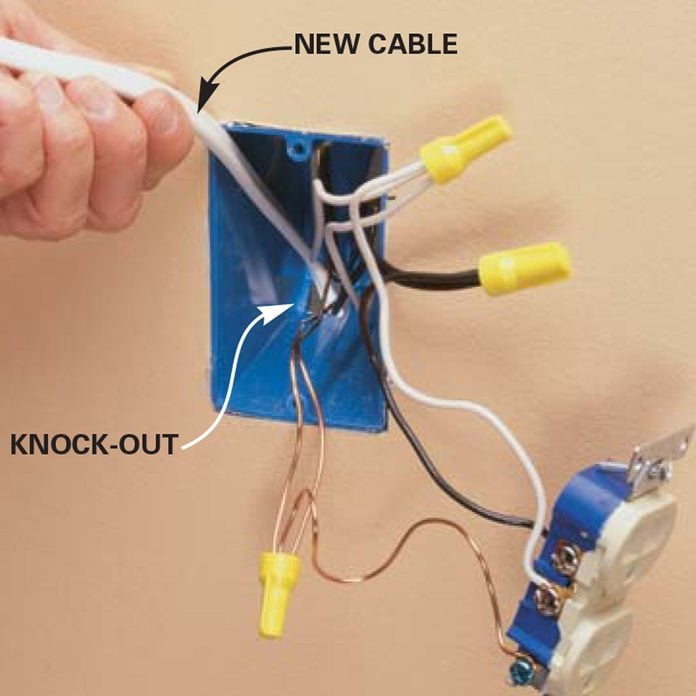
- Next, using a screwdriver, unscrew the existing outlet on the other side of the wall outlet from its box and dial out i of the knock-outs at the back of the box.
Hither'southward how to use electrical testers.
Aluminum wiring requires special handling. If you have aluminum wiring, call in a licensed pro who's certified to work with it. This wiring is dull gray, non the tedious orange that'due south characteristic of copper.
Footstep 2
Feed New Cable into the Wall
- Feed a length of new cable through one of the knock-out holes at the dorsum of the existing box (punch out the pigsty with a screwdriver).
- Feed through plenty cable to reach the new box plus an extra foot.
- Use xiv-approximate wire for a 15-amp excursion.

Step 3
Rewire the Existing Electrical Outlet
- Connect the wires of the new cablevision to the existing wires.
- Strip nigh x inches of plastic sheathing from the new cable to betrayal the black, white and copper wires.
- Run the new cablevision, with sheathing, at to the lowest degree two inches up within the box, and double over the excess wires to help hold the cablevision in place.
- Strip five/8-in. of insulation off the ends and connect the wires from the new cablevision to the existing bundles — white to white, black to black, ground to ground.
- Employ new wire connectors of adequate size for the iv wires in each bundle.

Step 4
Fish the Cable to the New Location
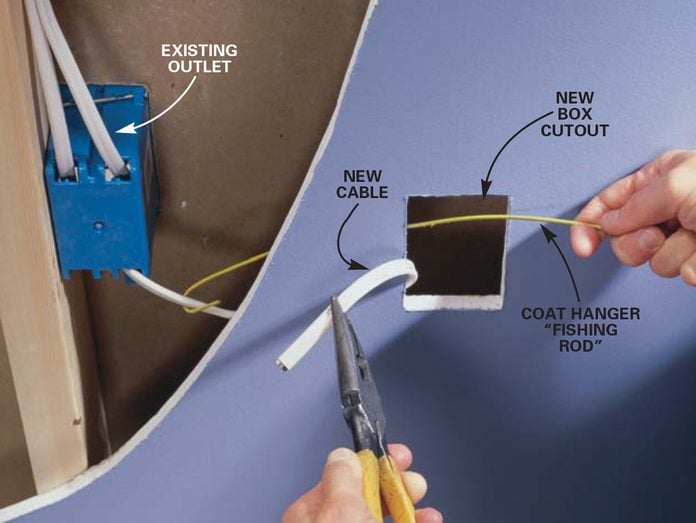
- Marking the opening for the new box and cut information technology out with a drywall saw.
- Fish for the new cable with a claw fabricated from a wire coat hanger.
- Pull the cable through the opening cut in the wall.
- Then strip about nine inches of sheathing off the stop of the cable. Insert the cable so the sheath extends most i inch into the box and mount the box in the wall.
Step 5
Wire the New Electrical Outlet
- Mountain the new box in the opening.
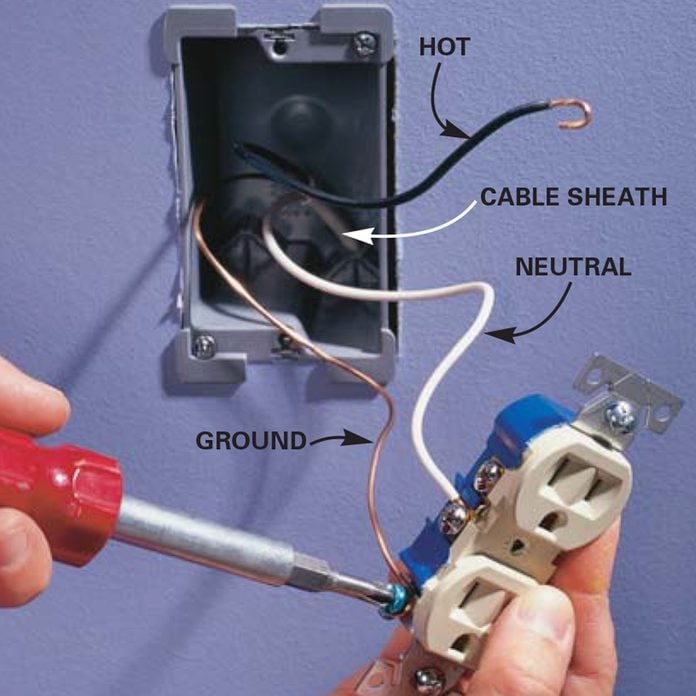
- Connect the new wires to the new outlet: white (neutral) wire to a silverish-colored terminal screw; black (hot) wire to a gilt-colored final spiral; bare wire to the light-green grounding screw.
- Make certain the cable sheath remains secured inside the box
- Finally, phone call the electrical inspector to bank check your work.
Originally Published: June 17, 2022
Source: https://www.familyhandyman.com/project/add-electrical-outlet/
0 Response to "How To Wire An Outlet With 2 Sets Of Wires"
Post a Comment