

How To Set Google Analytics For My Website
Accept you ever gone into your Shopify account and your Google Analytics accounts and discovered that they both evidence dissimilar website traffic numbers?
This is a common predicament that many eCommerce businesses and agencies observe themselves in (or whatsoever business concern that has Google Analytics set upwards across multiple websites.)
This ordinarily happens considering Google Analytics isn't configured to track multiple websites properly. So, y'all might have indistinguishable traffic or are missing a bunch of traffic altogether.
For example, hither are 3 use cases where y'all want to gear up Google Analytics on multiple websites.
- You have one main Shopify store for your visitor. Ex: TheHatShop.com. And then, y'all use a landing page tool like Instapage, LeadPages, or HubSpot to create multiple microsites on their ain subdomains. Ex: Wholesale.TheHatShop.com.
- Your blog is on its own subdomain. Ex: web log.thePPCshop.com
- Or, you run a fast-growing hamburger franchise. You lot have 25 franchise stores across the U.South. Each of these stores take their own localized sites, but they use the same template.
In this post, we reached out to 33 Google Analytics pros with tips for how to properly set up your Google Analytics when you take multiple accounts.
- Know the difference between accounts, properties, and views
- Add all sites under a single Google Analytics account
- Create multiple views for each property
- Add each site equally unique accounts
- Configure roll-up reporting
- Add your tracking codes in Google Tag Director
- Verify your analytics ready up in Google Tag Assistant
- Fix a custom dashboard to view all of your information in 1 identify
- Implement cantankerous-domain tracking
- Update your Referral Exclusion List
- Block bots
- Apply the annotation feature
Related: Google Analytics Reporting: A Consummate Guide to Reports, Metrics, Dimensions, and More
PRO TIP: How to track these 10 pop Google Analytics metrics
Sure, there are dozens (and dozens?) more GA metrics you could track. Just, starting with these 10 unremarkably tracked GA metrics will requite you lot a pretty high-level view of how your marketing is working…
- Sessions: The number of sessions can tell yous how many times people are returning to your website. Obviously, the higher the amend.
- Sessions by organic keyword: Which organic keywords bring in the most traffic to your website? This may help you determine whether your SEO investments are paying off.
- Bounce rate: Do visitors go out presently later landing on your website? Or do they stick around?
- Average session duration: How much time are people spending on your website? Users with a high boilerplate session duration are most likely relevant to your company.
- Goal completions: How many users responded to your call to activeness?
If you want to rails these in Google Analytics, you might notice the visualizations limiting. It's as well a bit time-consuming to combine all the metrics you demand in i view.
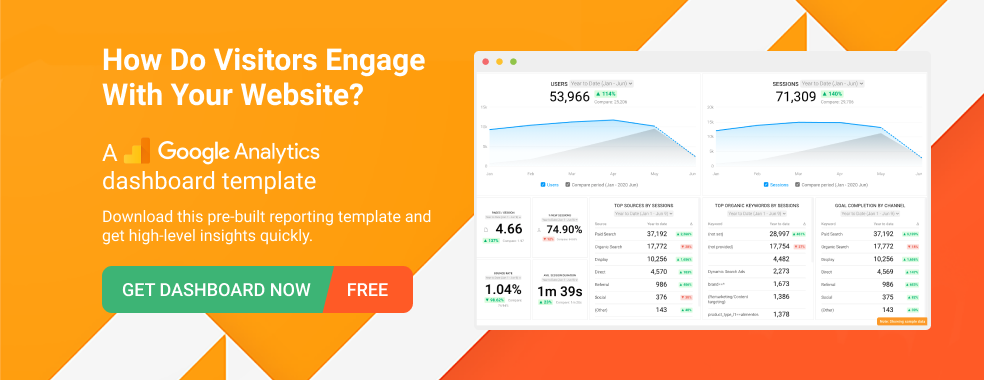
To ameliorate sympathise how your website performs in terms of traffic growth and conversions, nosotros've made this plug-and-play dashboard that contains all the essential metrics for understanding how successful y'all are at optimizing different aspects of your website.
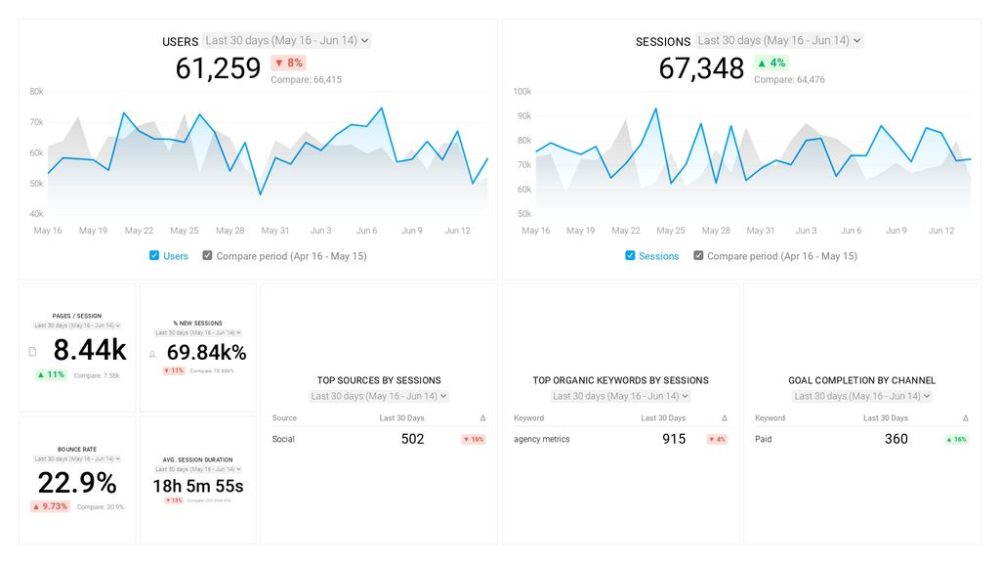
This Google Analytics dashboard offers a consummate view of how your website is performing and converting at-a-glance and helps yous gain valuable insights such as:
- How much traffic does my website get daily or monthly? (sessions)
- Which channels are driving traffic to my website? (sessions by channel)
- Which keywords are driving the nigh organic traffic? (sessions by keyword)
- How much time are visitors spending on my website? (average session elapsing)
And more…
You lot can easily fix it up in just a few clicks – no coding required.
To set upwardly the dashboard, follow these iii simple steps:
Step ane: Get the template
Step 2: Connect your Google Analytics account with Databox.
Footstep 3: Sentinel your dashboard populate in seconds.
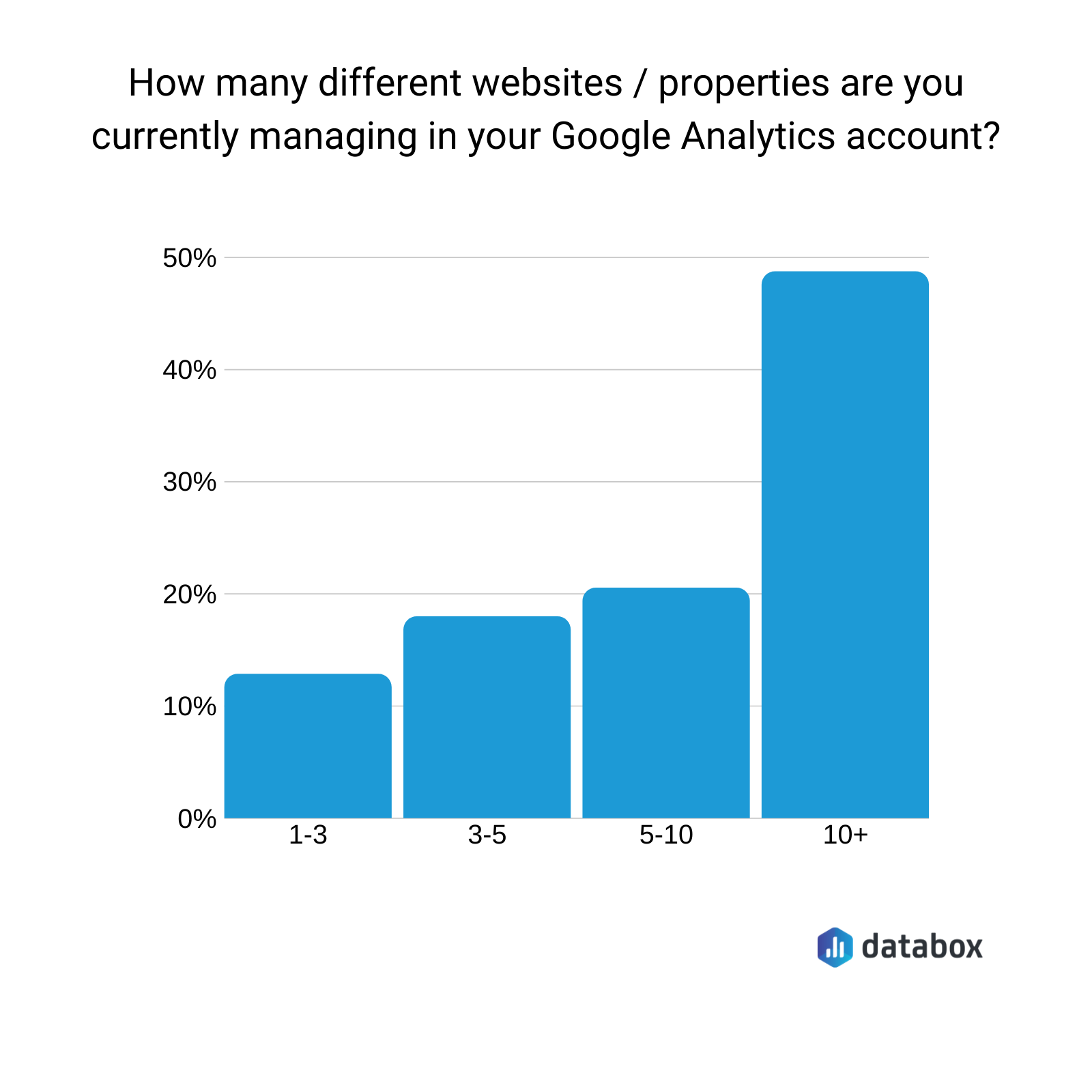
How many websites are you lot managing in Google Analytics?
Of the people we surveyed, nearly fifty% are managing 10 or more websites or properties in Google Analytics. When you lot are juggling that many Google Analytics sites, you lot demand a defined framework, or else you may discover yourself with a lot of incomplete or missing reporting data. For example, non existence able to run across how many people from ane microsite become back to your master site and vice versa.
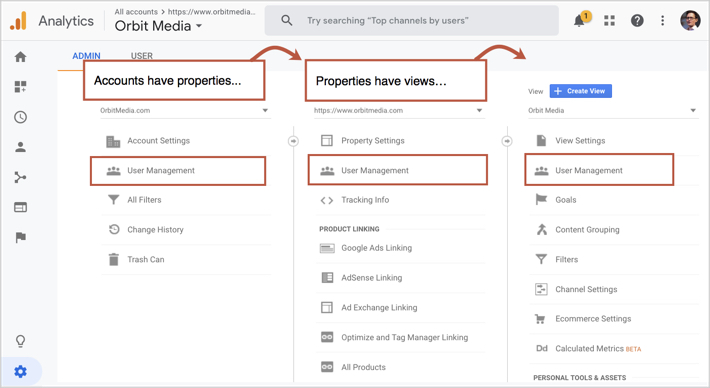
"In Analytics, your business is an "Account," and a website is a "Belongings," says Andy Crestodina of Orbit Media. "So proceed things organized and put every site under the same account. It's like a family with grandparents and parents. Within each property, there can be many different "Views." These are like the kids."

Yoann Bierling of International Consulting adds, "When sharing access with other contributors, brand sure that they have access to the right accounts or backdrop. Managing these two dimensions correctly can greatly simplify collaboration with other actors that need to access some analytics of some of the sites."
Since Google allows you lot to have upwards to 50 properties in one business relationship, this is the simplest option for tracking multiple sites. You can simply list all of your websites as "unlike backdrop" under this account.
Stein Jurgen of Smartphones Revealed says, "We collect all of our websites on the same analytics account. Otherwise, you can hands spend also much fourth dimension on making an overview of all your websites if you have many."
David Ehrentreu of Calibrate Media adds, "Keep it simple! There is no demand to brand things complicated. Make certain when you create a new Google Analytics property to create it from the top-level (Business relationship Level.) Since it is possible to make multiple tracking properties on ane website."
"Always nest your Google Analytics accounts for multiple sites under one master tracking ID.," says William Chin-Fook of Pickfu.com. "What that means is you set upwardly one account and and so set-up your different websites under this account. This will make it easier to keep tracking of Google Analytics properties and also organize them (and whatsoever views) as you create them."
Arvind Patil of SRV Media chimes in, "Use a single account id in Google Analytics and add multiple sites as different properties to track performance and traffic data. In gild to rail the customized details, you can create different views under a single holding."
In addition to creating a property for each site, y'all'll too desire to prepare multiple views for each property.
"Make sure to create multiple views for each property," says Alex Kalavrezos of Healthy Links. "In each view, take your data filtered properly so y'all can encounter data from organic, paid, social, etc. It's mode easier to analyze that way."
"Create custom views then you tin isolate sessions that commencement or end on a particular subdomain," adds Joseph Colarusso of CORE Search Marketing.
Lewis Peters of Online Turf adds, "One of the first things I do when taking over a new analytics account is ensuring that the data is as authentic as possible, past utilizing views.
A view enables you to run into your data from a certain perspective – and and so you can have many views within one GA holding. By default, you lot volition take 1 view named but 'all website information."
There are 3 views I recommend setting upwards for each website you lot want to track in GA:
- Your master view, where all appropriate internal filters & any goals should be enabled hither.
- A raw fill-in view, just in case something goes wrong with your main view
- A exam view that can be used safely as a testing surroundings without risking losing your main data."
Kim Doughty of Leadhub recommends taking this procedure a footstep farther by starring specific views.
"When using Google Analytics for multiple websites, the best matter you tin practise, particularly at an agency level, is to star the view yous are using most," says Doughty. "For i client, we may have more than than ane Google Analytics view, which can confuse team members working on the same business relationship. Staring the view prevents united states of america from sending inaccurate analytics reporting to clients and allows usa to stay organized on an agency level."
An alternative way to set this upwardly to add multiple sites in your chief Google Analytics as unique accounts. This allows you to track each site with unique Analytics tracking codes.
Jennifer Neylon of Supplement Warehouse says, "Create multiple Google Accounts per each website that you lot want to track. This way, you lot can track each website's behavior completely separately from each other."
"I'm the Co-Founder of ND2A Group, which owns a portfolio of websites which are visited over 2M times per month," says Robert Janes of ND2A Group. "I am currently managing 17 websites with Google Analytics. The most helpful tip that I tin can give anyone is to grouping websites by category or function. For instance, here at ND2A, nosotros have multiple websites that are in the health infinite, and so I created an analytics account chosen "ND2A Health" and create belongings tags for each website, app, and YouTube channel."
Khris Steven of Khrisdigital adds, "In using Google Analytics for multiple domains or websites, you have to create a new business relationship in your existing Analytics account from the Account cavalcade.
Here are a few tips to follow:
- Brand sure you enter an Account Name different from the one yous have already.
- Use a specific descriptive proper noun so that you tin can easily tell what the new account is for when you see the name in the Business relationship listing.
- Then brand sure to accept the default to add the business relationship to your current arrangement.
- And finally, if you lot plan on tracking more than than one belongings in this business relationship, use a specific and descriptive name. Then fill in other necessary details."
Abhijith VM of Geek's Framework adds, "Perfect account property and view naming could save you a ton of fourth dimension while doing analysis. This is particularly valid if you are working for an agency where hundreds of analytics accounts are continued to 1 chief account. The common practice is for clients to share access to their GA properties. Chances are they haven't thought about properly naming their backdrop. I've seen many using generic names. And then it's better to rename the backdrop and the views."
Jonathan Delfs of Trendhim says, "Implement (at least) ii accounts on your websites:
1) One full general account for catching all your domains. Really useful to become expert tracking of traffic yous go far through i channel to site A – where you lot link to site B. Then you tin can get a better overview of what y'all get from your advert spend.
two) Add together another business relationship/view uniquely per domain/market, to go a single view of that market. Great to avoid sampled data, when your sites get also big to fit a standard free Analytics programme."
Drew Beechler of High Blastoff adds, "Brand sure you set up a custom filter in club to brandish the full URL string. This will permit you lot use the same GA tracking code on multiple websites and create custom segments around unlike URL strings to view the different website viewers."
"Making sure you are using a roll-upwardly business relationship will help yous get an overview of all of your websites in one identify – but will still allow yous to run into the data for each website separately," says Jill Caren of 2 Dogs Media.
Patricio Quiroz of Code Say-so adds, "Roll-upwards reporting will collect data from multiple Google Analytics properties, which will permit you lot to run across that data in the same report if yous would like.
An example of this would be if yous ain several properties in different countries, you could then collect this data to compare metrics globally and drill down even further to compare properties in different countries. The advantage of the coil-upward reporting is that you lot have ii options in aggregating your data. You tin set up individual analytics properties that will include data from a unmarried website, and so you have the multiple belongings view to include all of your backdrop."
"To utilize Google Analytics on multiple websites, my 1 tip is to use Google Tag Manager," says Samuel Schmitt. "With GTM you will be able to prepare up different Google Analytics tracking for different environments. In other words, each website volition have its own Google Analytics Tracking ID (UA-XXXXXX-10), and everything managed centrally from Google Tag Manager."
Omar Fonseca of Medicare Program Finder adds, "Google Analytics is the ane-finish-shop for all website performance, traffic information, and analytics. When you take multiple websites to rail, you lot can use a single account to add together multiple sites in Google Analytics, which can exist done in ii means.
You can either add all your sites under a unmarried Analytics account as different properties or add a unique Analytics account ID to each individual site. And then the nigh of import footstep happens; multiple websites ways a multitude of codes to enter in your website.
In order to keep all your codes in one place, which will provide you with only one handy code needed for your website, y'all must set up your subdomains correctly using Google Tag Director (GTM). GTM allows site owners to store, manage, and deploy all your tags to your site from one location. That way, if you are tracking data with multiple different programs instead of having all those scripts within your header which tedious your website down significantly. GTM produces one script, which represents all of your tags in GTM, so Google only has to read one script instead of many. With site speed being so important, this reduces the requested resources and keeps your website running smoothly and fast!"
Krzysztof Surowiecki of Hexe Data adds, "I recommend having a detailed Google Analytics implementation framework according to which all new site implementations are carried out. Such a framework defines, among others, basic GA configuration rules. It defines any boosted elements that are added to the standard GA configuration, east.chiliad., events, custom dimensions, calculated metrics, etc. Information technology defines the naming of elements. In add-on, all implementations are implemented through the tag manager, which allows for quick and efficient management."
"The almost important thing to do is e'er to make sure that you are looking at the correct site," says Andrea Bailey of Tandem Interactive. "Use the Google Tag Assistant to check that the analytics lawmaking matches what you are looking at. From here, it is important to focus on ane site at a time to ensure that you practice not get confused. Taking screenshots if you lot are looking to compare clients side-by-side or jumping effectually tin can be helpful besides. If y'all cheque the analytics frequently, you volition too start to go more familiar with each site's trends and be less probable to get confused."
"Create a custom web analytics dashboard that has all the most important information for your niche, and utilize that for all your websites' analytics," says Toni JV of JVT Media. "This will manifestly differ from every website and business depending on their goals, only if you work in a specific niche, oftentimes, you tin duplicate the dashboards from your other website'south analytics, saving you fourth dimension and headache. Now you can quickly go and look at the nigh important information for your website without getting confused and overwhelmed. And most importantly, keep it uncomplicated. You don't desire to overcomplicate this and overwhelm yourself by tracking too many websites and too much data all at once."

Jasmine Hippe of Augurian adds, "To easily view all of your Google Analytics data in ane spot, I recommend using Google Information Studio. They have templated reports, or you tin create your own custom study to bubble upwardly insights from all of your GA backdrop in one easy-to-access spot."
Volition Craig of LeaseFetcher says, "Google Analytics is our website tracking treasure chest containing all our own, as well as, all our clients' traffic and functioning information.
When analyzing data from multiple sites on Google Analytics, nosotros highly recommend that y'all consider cross-domain traffic. Implementing cross-domain traffic means that cookies from one site are passed onto the next, ensuring that the visit data is reliable and authentic.
If y'all determine not to implement cantankerous-domain tracking, all of your sites will appear within the same referral traffic written report, which evidently affects the accuracy of this data."

Noriko Harada of 45/RPM adds, "This is the first and most important matter you need to practice. This will affect how you see data from referral traffic to eCommerce transactions. If yous miss this, the data you see on GA might not be correct, and you might lose some opportunities to improve paid and organic efforts."
Once you lot implement cantankerous-domain tracking, you'll also desire to update your referral exclusion list within Google Analytics to ensure the near accurate site data.
"In some situations, a visitor has multiple websites that equally a whole are treated equally 1," adds Dylan Zsigray of Kiwi Creative. "For case, a website could have multiple subdomains (due east.k., a weblog) that are technically "independent" but are ordinarily treated every bit part of the parent site. While a user may come across a different UI for each site, you treat them as joint as they serve a larger purpose. To avoid having inaccurate data in Google Analytics for your goals, it is beneficial to add together sites to the referral exclusion listing for each applicative property. This ensures that if a user leaves your site and goes to one of your subdomains, they will not be counted as an entering referral each time. In other words, a user will travel in-between your sites freely without messing with your information."
Aqsa Tabassam of Brandnic adds, "If you are using Google Analytics for multiple websites and these websites have their subdomains as well, along with the master domains. This situation might cause a discrepancy in analytics provided by Google and your private web traffic tracker."
"With any cross-domain setup, you should too recollect to add any domains yous're tracking to the Referral Exclusion List," says Anthony Espinoza of TopSpot Net Marketing. "Any websites added here volition ensure the original, accurate source is kept and will prevent "self-referrals." This feature is but available to the Universal Analytics version of the tracking lawmaking, so make sure the code is up to the latest standard."
Axel DeAngelis of NameFeedback.com says, "For microsites/subdomains, information technology'south important to gear up up referral exclusions so that users who click from your main domain to your subdomain only count as one session."
Ballad Hill of Analyticshelp adds, "Make sure that cross-domain is working correctly on all websites and add the websites to the referral exclusion list in Google Analytics."
"If you're using Google Analytics on multiple websites, be sure to adjust your settings to block known bots automatically," says Stan Mead of Meridian Dwelling house Buyers LLC. "Bot Traffic describes whatever non-human being traffic to a website. Some bots are adequate, but some are malicious and can skew your data."
"Using annotations allows you to identify changes that have been made to your websites as you monitor sessions, users, and behaviors across your spider web backdrop globally," says Daniel Kraciun of discover.jobs. "Annotations is one of the most usable and undervalued features within Google Analytics for multi-site management."
***
In sum, if you lot have multiple websites, there are two main ways to configure Google Analytics.
- Yous can add together all of your sites equally different backdrop nether your main account.
- Or, you can add together multiple sites in your main Google Analytics as unique accounts.

How To Set Google Analytics For My Website,
Source: https://databox.com/how-to-use-google-analytics-across-multiple-websites
Posted by: derossettreocken1946.blogspot.com
0 Response to "How To Set Google Analytics For My Website"
Post a Comment